Introduction
Open City was presented on 20 May 2026 as part of the ISPA 2026 Singapore Congress. It was envisioned as a series of diverse encounters where delegates could discover three arts spaces in Singapore - Goodman Arts Centre, Aliwal Arts Centre, and Stamford Arts Centre and the Waterloo Arts Belt. In each arts centre, delegates went on a ‘tour’ through rehearsal spaces, studios, and performance venues, where they met and learned about the artists and arts organisations which call these centres home.
Alongside several other individuals and groups (Dingyi Music Company + Shantha Ratii Initiatives, Julius Foo, P7:1SMA × Cherry Chan × thesupersystem, Rizman Putra × Azizi, and Traditional Arts Centre), Centre 42 participated in the Open City programme at the Stamford Arts Centre. The Stamford Arts Centre ‘tour’ opened with a specially catered lunch by Eight Treasures Vegetarian Restaurant, held at 42 Waterloo Street (which Centre 42 has called home since 2014). After lunch, delegates walked down Waterloo Street to Stamford Arts Centre, where they were split into six groups. The six groups visited the various organisations and artists via different routes, with each encounter lasting approximately twenty minutes.
We introduced the delegates to Centre 42’s work through a part-installation, part-interactive experience that put the spotlight on our archival and documentation efforts. This experience centred around the late great local theatre director William Teo, who was active in the 1980s - 2000s.
Teo was best known for founding the Asia-in-Theatre Research Centre, a theatre company renowned for unique, experimental productions which combined Eastern art forms with Western contemporary theatre. He was also the artistic director and consultant of Festival Village, first presented as part of the Festival of Asian Performing Arts 1997. The Festival Village emphasised community-building, bringing artists and audiences together in mutual understanding and appreciation.
Centre 42 took inspiration from the ethos of Festival Village and reimagined it for our Open City encounter. We hoped that, in the short twenty minutes we had with each group, we could allow delegates to experience that same sense of community with us. We also hoped for them to leave with new knowledge of an impactful theatre practitioner with whom they were previously unfamiliar, and a deeper understanding of the work Centre 42 does to ensure such practitioners are remembered for the future.
Concept and Execution
When delegates first arrived at #03-01 at Stamford Arts Centre, they encountered a ‘holding space’ where they were introduced to the installation and experience. They were prompted to imagine that they were encountering the ‘Centre 42 of the future’, which was framed as one ‘archival node’ out of several all around the world, all coming together under a network called ‘The Village’. These different ‘nodes’ document little niches of theatre history, and delegates were now invited to view the documentation and archival process at work, and participate in it as well.
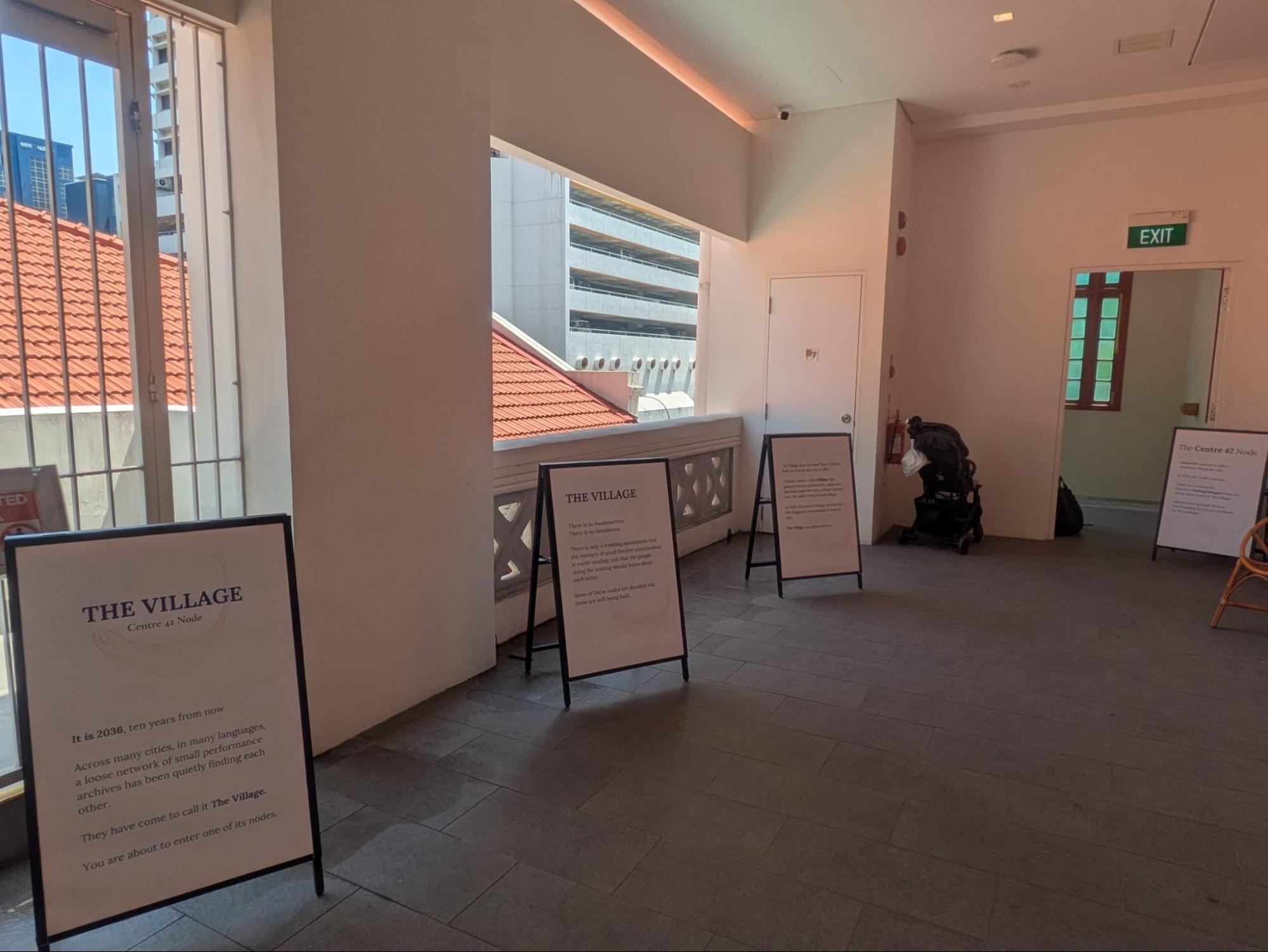
The holding space, featuring informative boards about ‘The Village’.
When delegates stepped into the room, they found it filled with artefacts related to William Teo’s practice - particularly programmes, photographs, and audiovisual stills from productions staged by Asia-in-Theatre Research Centre, the theatre company founded by William in 1987. Artefacts were placed on tables scattered around the room, and accompanied by accession logs which provided delegates with more context about their significance, allowing them to better understand William’s work, process, and the impact that he made on Singapore theatre at large.
Alongside these artefacts, delegates could also view a 40-minute documentary film exploring William’s life and career. This documentary film was created and presented by Centre 42 under the auspices of the Singapore International Festival of Arts 2026.
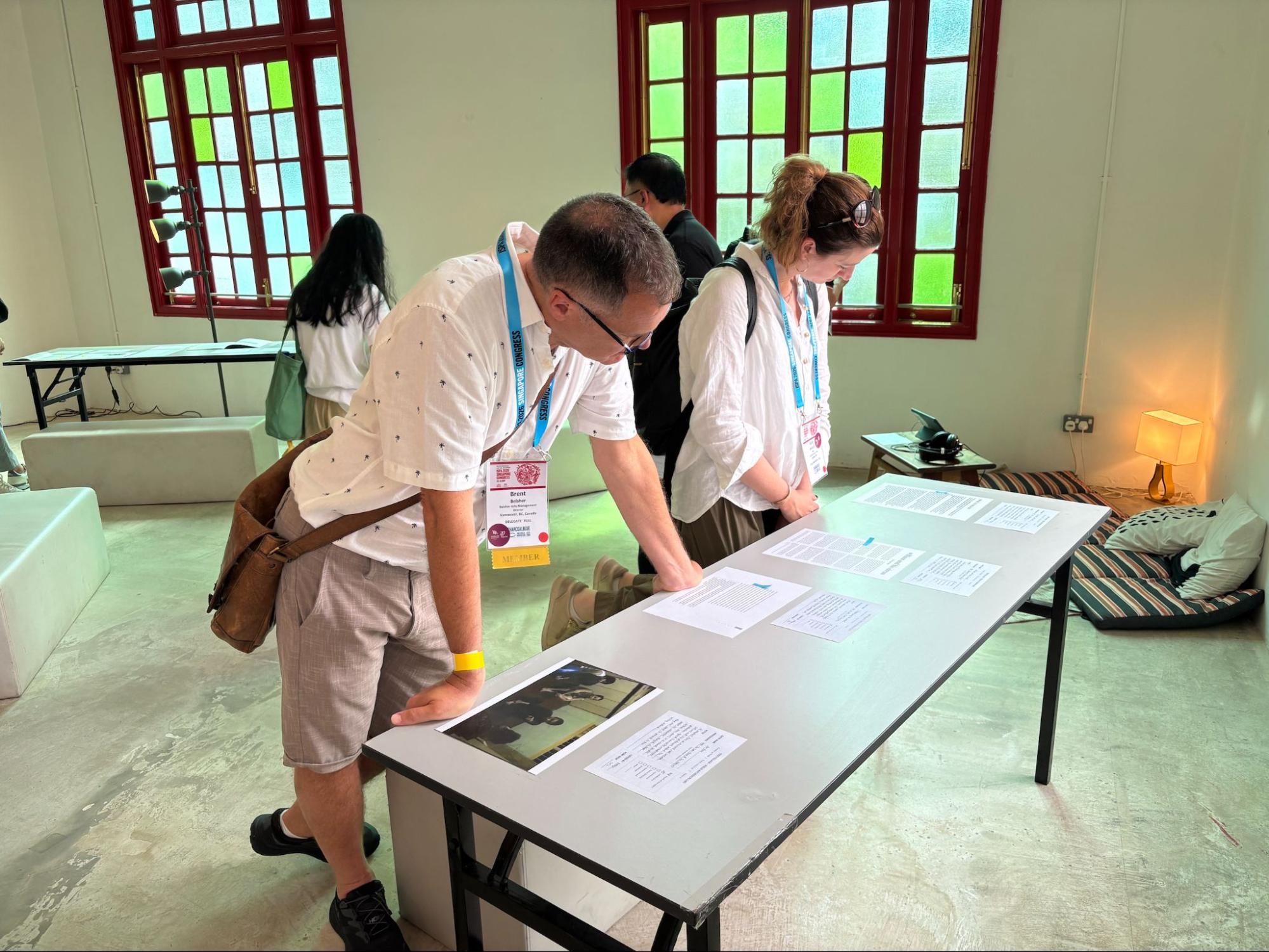
Delegates viewing the artefacts spread out around the room.
Artefacts were categorised under five themes which best described William’s practice - experimental, collaborative, human-centred, future-thinking, and passionate. Each artefact demonstrated one of these aspects of William’s work. Click below to view all the artefacts on display during Open City, and their accompanying accession logs.
Beyond simply viewing the artefacts and accession logs, delegates were also encouraged to let these items inspire them to reflect on their own personal and professional contexts, practices, and processes. They were asked to write down these reflections on an accession log of their own, and leave them on a wall in the room, so that the next group of visiting delegates would have the opportunity to view these responses, and possibly take inspiration from them as well.
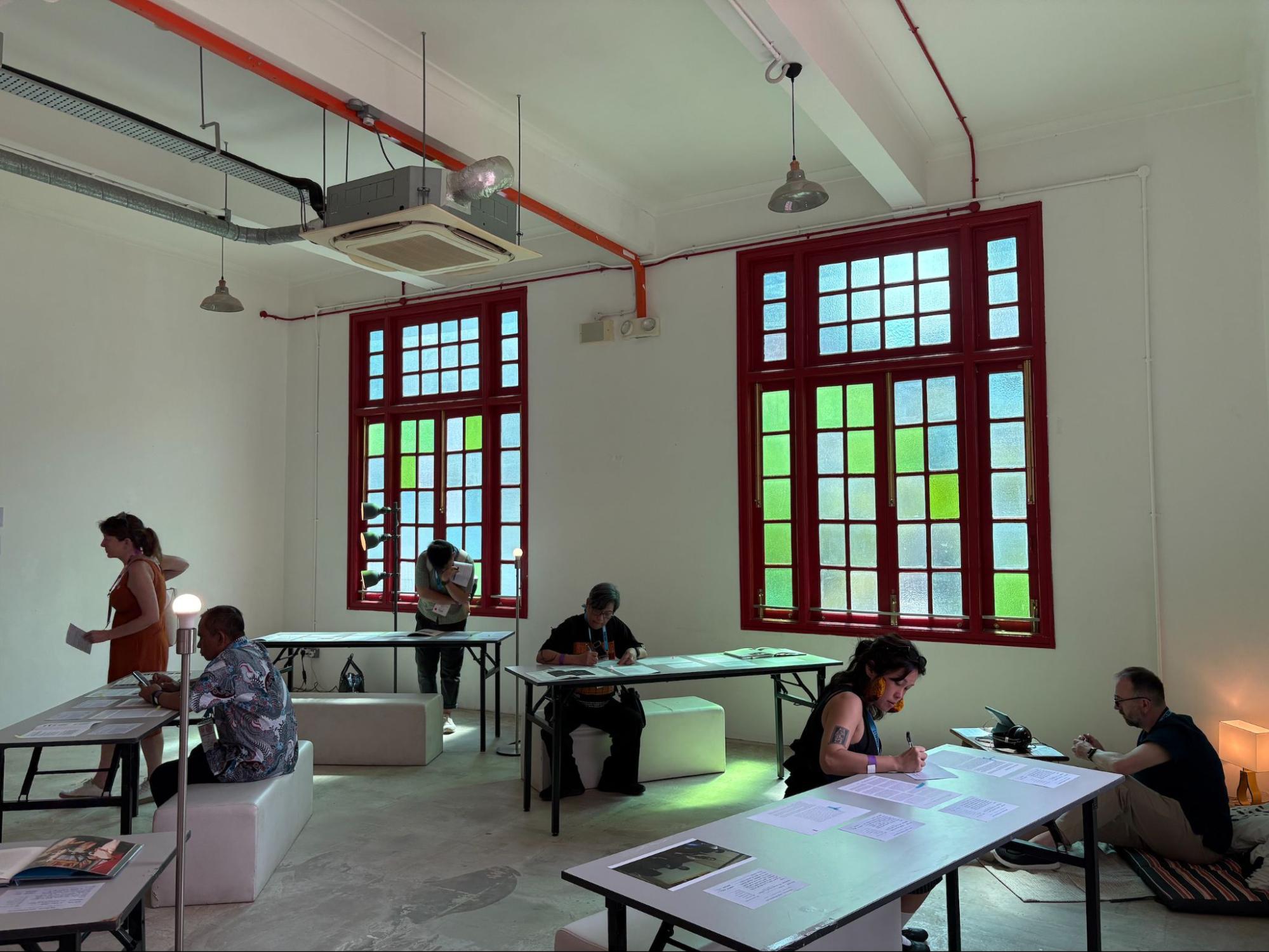
Delegates filling in their accession logs.
A total of 34 delegates filled in accession logs, sharing a variety of reflections. Some wrote about productions and events they had worked on which shared similarities with one of William’s works; some reflected on their personal experiences with seeing William in action back in the 1980s and 1990s; some mentioned taking inspiration from William’s unique approach to theatre for future works of their own. Click below to view all the accession logs left behind by the delegates.
At the end of the encounter, delegates were given farewell tokens to take away with them. These tokens were styled like name cards. The front face featured a quote by Singapore theatre doyen Kuo Pao Kun, taken from a review of Medea, presented by the Asia-in-Theatre Research Centre in 1988. It prompted delegates to reflect on the wider historical context in which the artefacts they had viewed existed, and the importance of Centre 42’s documentation and archival work in a profit and goal-driven world today.
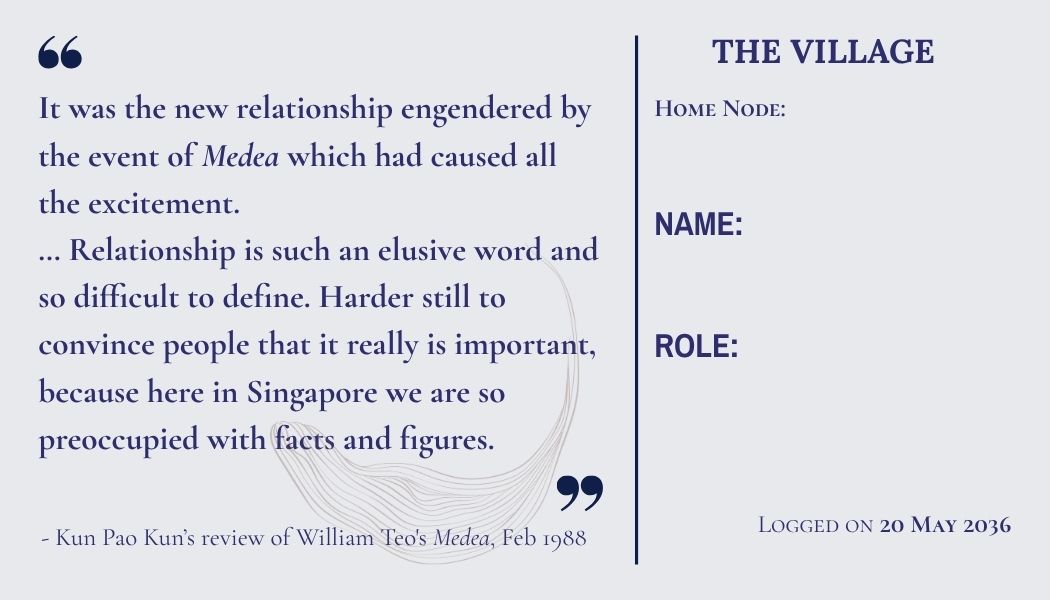
Front face of the farewell token distributed to visiting delegates.
Delegates were also encouraged to fill in their name, ‘home node’ (place of origin), and role (a role they imagined they could take on in ‘The Village’ of the future. They thus became part of this imagined global network of archival nodes - part of the complex and interconnected archival and documentation process that Centre 42 will continue to engage in for time to come.
Reflections
Centre 42 wraps up our Open City experience with post-programme reflections from Adelyn Tan (project researcher and Documentation Executive at Centre 42) and Shawn Chua (project conceptualiser).
Open City gave delegates the opportunity to engage with Centre 42’s documentation and archival work in an accessible way. The process is so often opaque due to how complex, time-consuming, and behind-the-scenes it is, and being able to lift the curtain in any small way is very valuable. The encounter provided insight into the way that we present documented material to the public, the way we draw connections between the events of our past and the impact that they can have on the present, and the fact the relationship between archive and audience is not one-way; in fact, they can enrich the archival collection through their own analyses, reflections, and responses to existing artefacts.
– Adelyn
The encounter that we created for Open City was, at heart, about capturing Centre 42’s relational ethos - building a relationship between the artefacts, William’s work, and our archival process with a transient group of people who had little to no familiarity with Centre 42 or with Singapore theatre. That is, after all, the core of the C42 Archive of Singapore Theatre - allowing present-day users to build and develop a connection with a theatre history that they are unable to personally experience. By framing Centre 42 as one archival node amongst a network of others, we centred that sense of community and solidarity from the beginning of the encounter. It demonstrated the ‘village ethos’ - and how fittingly, considering William as the central subject matter, as William’s work was so much about collaboration, about bringing people together. The encounter echoes ISPA 2026’s tagline - allowing people to view these slices of theatre history and connect them to their own artistic processes is the definition of creative convergence, and a neat demonstration of how ‘same same, and different’ we are.
– Shawn
Published: 15 July 2026