Political Paralysis: Documenting "(in)action"
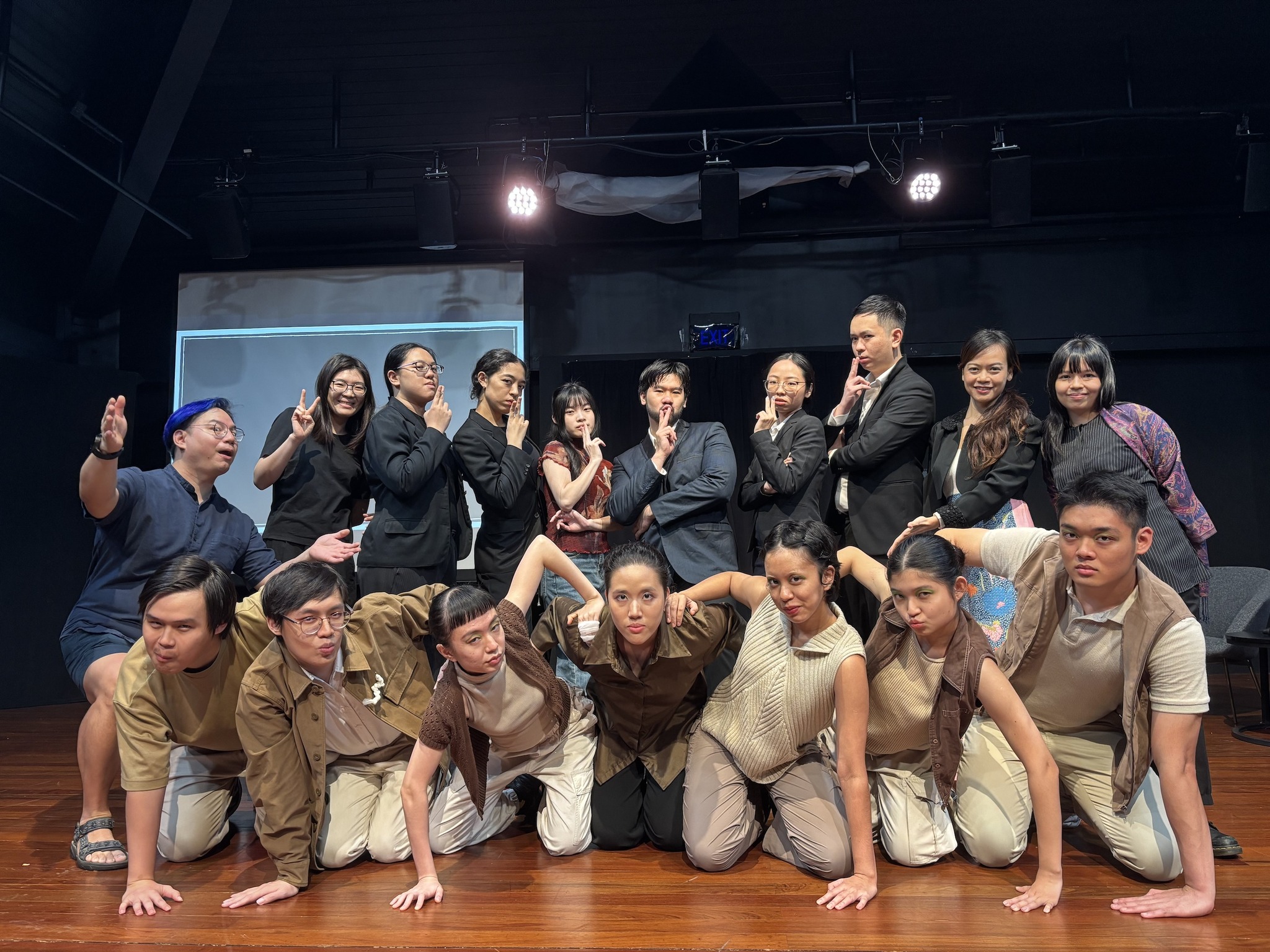
[From left, top] Henrik Cheng, Stella Cheung (technical consultants), Deborah Chai, Alicia Chang, Renee Chia, Charleston Chan, Marie Chua, Elvin Tee, Thong Pei Qin (course chair), Celine Sara Thio (producer and co-dramaturg)
[From left, bottom] Royston Soh, Marcus Tang, Lim Kai Ling, Evangel Wong, Sarah Zafirah, Madeline Yeo, Yeshe Koh
This essay accompanies the students' devised performance piece, (in)action, created as part of TS3103 Theatre Lab (a core module for Theatre Studies students in NUS) and as a part of The Vault Residency with Centre 42. It serves as a critical and reflective inquiry into the thematic, conceptual, and artistic concerns that have shaped their works.
What are your groups' artist statements and why did you decide to explore this?
Defamation – Begins With Me (DBWM): We are of the opinion that political apathy is rampant in Singapore, but it is not possible to truly be politically apathetic – most people do have an opinion despite being aware of it or not. As such, our piece is meant to provoke the audience to critically think and reflect on their own political opinion, with the end product being an interactive play laden with a multitude of perspectives and distractions that implicates the audience. This is from our stance that The Campaign to Confer the Public Service Star on JBJ as a political play absorbs us into its narrative and asks us to root for its characters, without allowing its audience to consider how they really feel about Singapore politics. We wanted to do the opposite of that and get the audience to take a stand.
Rare Specimens (RS): Our artist statement: Our response aims to interrogate how knowledge about politics in Singapore is produced, represented and interpreted, and how these representations are used / reflected / reinforced by both the producers and receivers of this knowledge. One way that people often react to politics in Singapore is through inaction, which we interpret as a form of paralysis. There are multiple ways which paralysis manifests itself, like passivity, resignation, and even disempowerment. We want to demonstrate that paralysis functions as a mechanism of punishment and control to limit grassroots political activity in Singapore. In Singapore, it feels like not acting can feel paralysing as you feel like a controlled subject, but acting may also result in being punished through paralysis.
Through our piece, we hope audiences become more aware of the roots of their paralysis, and can identify systemic reasons for paralysis in our culture. With this awareness, we aim to highlight a possibility where we have the agency to resist paralysis (through grassroots community action as a form of political involvement).
We aimed to explore how political knowledge in Singapore is produced and reproduced, and how Singaporeans engage with political experiences, while creating more nuanced representations of activism. We found Wong’s character of David to be one-dimensional and misaligned with real-life activists. While David acted alone in the play, we emphasised the power of both collective and individual action in activism.
Throughout the devising process, we consulted our artist statement to avoid stereotypes and present diverse perspectives on activism. Recognising that speaking out can feel daunting, we used theatre as a space for critical reflection on societal pressures and individual choice. Rather than prescribing a single viewpoint, we aimed to offer a more complex understanding of political engagement while emphasising that change is possible through personal and collective action.
What were your groups' initial approach to "The Campaign to Confer the Public Service Star on JBJ"? How did you arrive at where you are now?
DBWM: We felt that the original JBJ text was grounded on a "distraction" – it used a very linear narrative to try and nudge the audience into taking a cynical view of the nature of activism and bureaucracy. We decided to challenge this hidden "distraction" through foregrounding distractions: an immersive experience where the audience witnesses in real time the breakdown of institutions. We were initially intending to explore distraction in a more fantastical and absurd way, but we put a lot of thought into how different kinds of political plays were executed and how we could create one that would affect the audience enough for the piece to explore apathy and empathy. We also thought a lot about Singapore’s culture of blending in or non-action, conforming to an "oppressive" society. This in addition to our limited number of actors to handle a large audience led to a work that involves audience interaction with such undertones.
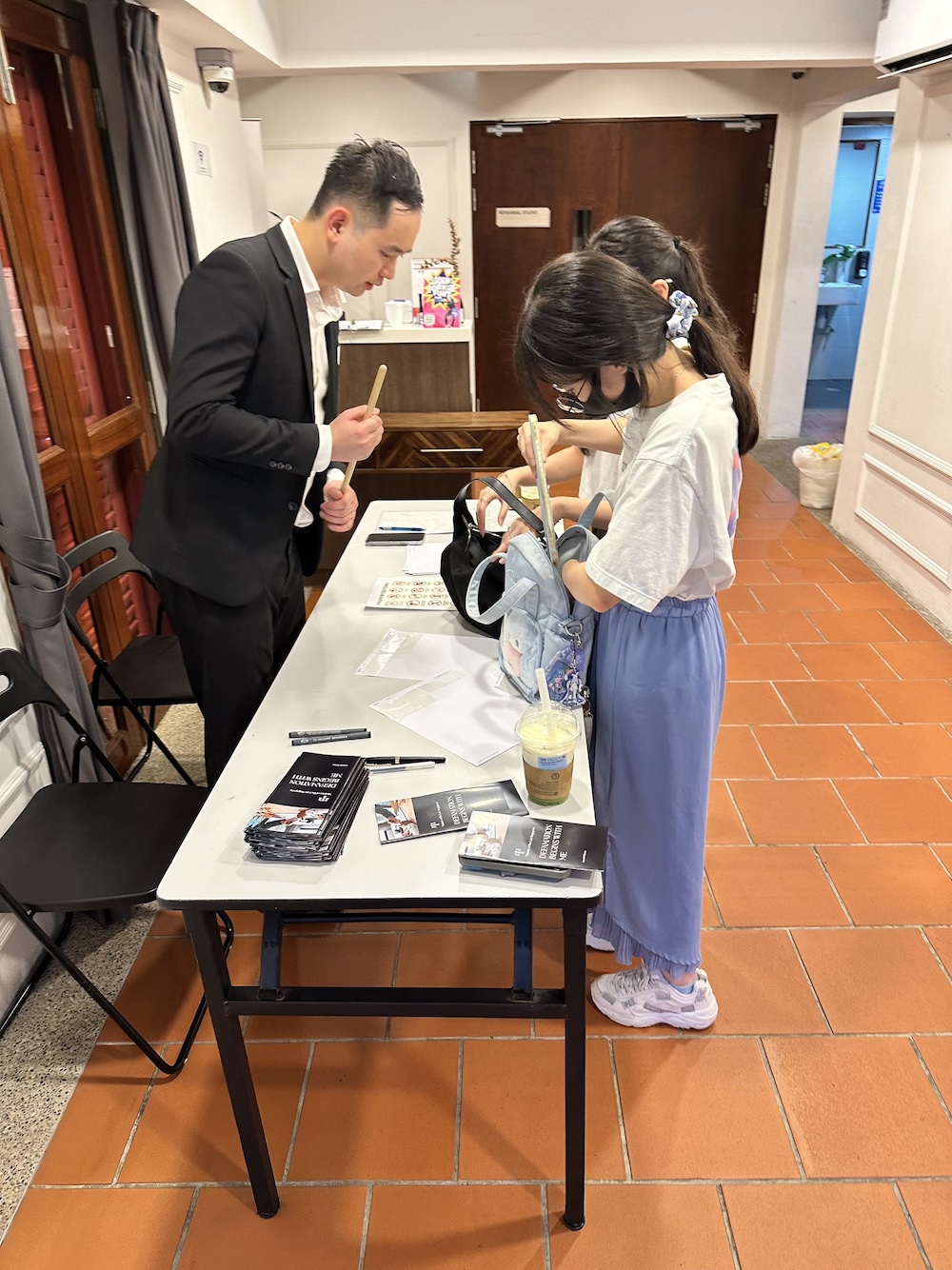
For Defamation – Begins With Me, audience interaction began at front-of-house, with one of the student-performers checking audience members' bags before they were admitted into the Black Box.
RS: Our first hurdle was justifying our choice of insects as a metaphor. We linked this to David being described as a "rare specimen", positioned as an outsider who defies norms and expectations. We also wanted to unpack his rationale as an activist and explore how we could respond to his intentions.
Our initial approach in Presentations 1-3 focused on the ways that “diverse individuals manage their own needs alongside community needs during times of crisis, under various axes of oppression.” We worked in a cast of seven characters to explore activism in Singapore as a group practice. These characters lived together in a tree, which, when threatened, brought them closer together and catalysed their political action.
As the piece developed, we pared down elements to clarify our message. We changed our setting to a web to better represent paralysis. We then reduced the number of characters from seven to four, allowing for more nuanced portrayals and growth. We also reframed the "rare specimen" activist: beginning as a "pest", she reclaims the "rare" label, suggesting that speaking out should be more common. Finally, in response to feedback about a lack of grounding, we wrote a new scene referencing real-life protests and social justice groups that inspired us as artists and creators.
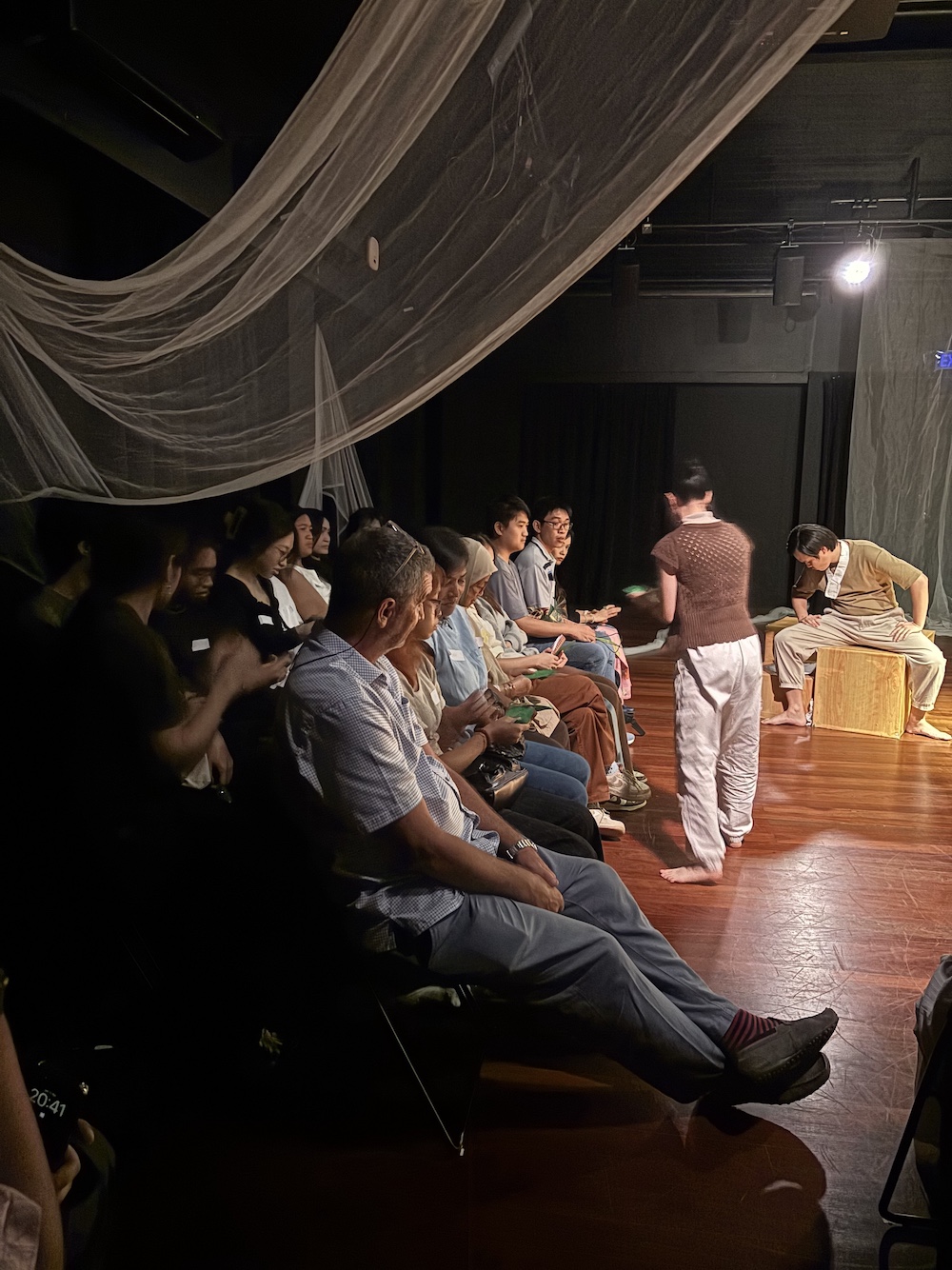
Rare Specimens' set featured thin, translucent sheets draped around the Black Box to give it a web-like appearance.
How did the story of your respective responses emerge? What are the intentions behind the responses?
DBWM: Upon reading The Campaign to Confer the Public Service Star on JBJ, we researched on the real JBJ and were fascinated by his "downfall", mainly his legal clashes where PAP politicians weaponised the defamation law to bankrupt him out of parliament. We were interested in how (defamation) law transformed from a social institution to a private weapon for those in power to "destroy" their opponents and found it to be quite allegorical about the anarchic undertones of seemingly bureaucratic society. Defamation cases were also relevant to our audience because high profile ones, usually regarding politicians, are covered in the news a notable number of times. To make use of this while showing nuance more reflective of reality, we wrote fictional stories that utilised this law but did not have clear right and wrong. For the story itself, we chose vaping as it is being campaigned against rigorously by the government, such that the connotation of it being "wrong" could cause the audience to conflate the "wrong" of vaping with the justification of defamation — prompting audiences to think harder about where they truly stand.
RS: Rare Specimens began with a pitch proposing that insects as a metaphor for oppression and hierarchy. Humans often view insects as nonbelonging and seek to exterminate them, even though we exist within a shared ecosystem. This led us to consider how we might extend the same advocacy we give to plants, mammals, and marine life to insects.
As we developed this idea, we began formulating a character-driven script exploring inter-insect hierarchies, and the different needs of each insect within a shared council setting.
Even as our initial idea of portraying insects (sans human presence) shifted into a metaphor for human behaviour, we always intended to portray diverse perspectives towards political action and what it means to act within a community, ultimately ending with a message of hope for the audience to reflect on.
What methods did your groups use to build the worlds of your responses? What were the intentions?
DBWM: As it was based on the legal system, we had to do a lot of researching. This includes public talks and defamation law. We took a theoretical and democratic approach to our theatre making process, and it was very heavily conceptual in discussion. This helped to create a strong foundation of our standpoint, and explore the different angles we could take, especially with such a nuanced and unfamiliar topic. With our intention to create an oppressive atmosphere that likens how Singapore society operates in terms of suppressing activism and oppositional voices, we started the immersion from registration and seating onwards, costuming and atmosphere. This created the stakes needed for action or inaction by the audience. We also used hot seating to develop our stories and our characters, and we utilised writing exercises to find and build our narrative. A big part of our process was with trial and error, as we needed to test our ideas on an audience to gauge how they felt and respond, which is something we could not do by ourselves. A shoutout to Rare Specimens!
RS: We researched different insects and translated their traits into characters, playing with expectations. One early example was Mariposa, a moth who aspired to be a butterfly. We then applied Haresh Sharma’s 8-questions method to create nuanced characters with varying levels of political engagement. Using these, we devised short scenes to explore plot tensions and character interactions.
We also explored movement, embodying insects, nature, and activism. In one presentation, we formed a tree with our ensemble and used tableaus to convey action without text.
However, we realised that the world was becoming too “cartoony”. To maintain relevance to contemporary Singapore, we grounded our characters in real-life parallels. Professor Silva Feesh drew from journalist Kirsten Tan’s relationship with activism, while Cecilia, our protagonist, incorporated our own thoughts and anxieties of young people.
Furthermore, we experimented with materials such as cloth and crepe paper to visually represent the government and self-imposed web respectively. We considered the internal logic of the materials and set and how design could create and convey meaning more nuanced rather than purely, literal meanings. The materials and characters in our piece thus grew to be important grounding points to give audiences different ways into the show.
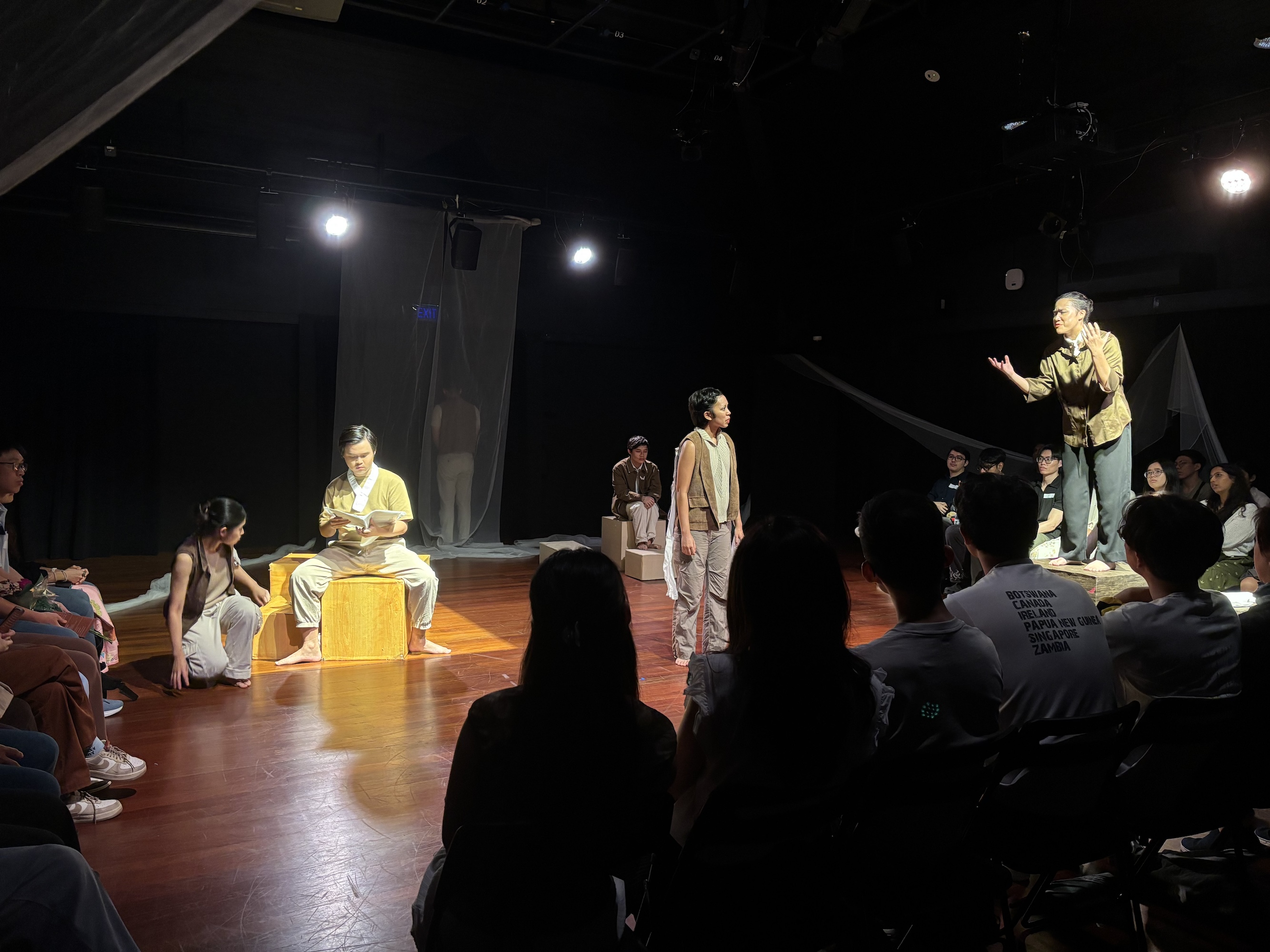
A scene from Rare Specimens featuring main character Cecilia (middle) and Professor Silva Feesh (right).
What was the devising process like?
DBWM: The devising process involved discussing extensively about the concept of our work, the approach and tone, and how audiences might react, as well as various devising tools such as writing, hotseating, and collective ideation. Over the semester, we went through a lot of trial and error to create a work that affected the audience in the way we intended, especially since our work relied heavily on test audiences which we could only access during class presentations. Feedback from these presentations also contributed largely to our process, which we used to continually define and refine our work and its intended message and effect.
Has working on the piece changed your groups' perspective on the topic?
DBWM: Across our intermediate presentations, we faced many hurdles in simply "completing" them without facing major failures in getting the plot across. We realised that our baseline assumption: the audience is inactive and thus apathetic – was untrue given the opportunity to act, most of the audience became very disruptive and chaotic (without any clear political motivations). This made us realise that we cannot equate social inactivity with political apathy; people can remain politically apathetic even if agency is offered in the space, and as Rancière says in The Emancipated Spectator, an inactive audience doesn't mean an unthinking, political apathetic one.
We also learnt to move away from our initial approach of a gradually loud and absurdly comedic plot as an alienating commentary about the weaponisation of law. This came through understanding the importance of stakes that the audience can feel compelled to, within an immersively “real” setting. We grew to understand that a veil of realistic stakes framed with a more serious tone can be a more accessible way of “weaponising” distractions in our commentary on political apathy. To be realistic is more than just mise-en-scene but aligning with the audience’s positionality: situating them into realising their political opinions without a satisfying "resolution" of performing any political "acts".
RS: Working on the piece has changed our perspective on activism in several ways.
Our focus shifted from activism as a response to major crises to its presence in everyday, interpersonal contexts and its relationship to systemic issues. This is reflected in our shift from an inciting incident about a tree being cut down to questioning why the WEB system exists at all.
Additionally, rather than simply opposing Wong’s perspective, we turned the lens on ourselves, examining our own responses to activism. By drawing from our personal experiences, we prioritised specificity to allow for greater authenticity.
Finally, we learned to navigate sensitive political topics through metaphor without losing sight of real-world impact. The WEB metaphor shows us how staging, movement, and design can embody perspectives beyond what text and body alone can convey. We learned to incorporate design as part of our devising process and central metaphor, instead of as an afterthought.
What would your like your audience to take away from your pieces?
DBWM: In the end, our piece wasn’t so much that people needed to have a "political opinion" and take a stance against "political apathy", but that everyone constantly makes political choices and that there are invisible institutional norms that nudge all of us into making unconscious binary "choices" all the time. Our piece had a "hidden" third option which only one audience chose (to vote neither), and we want to affirm that as a choice as well – it was still an active choice that they consciously made.
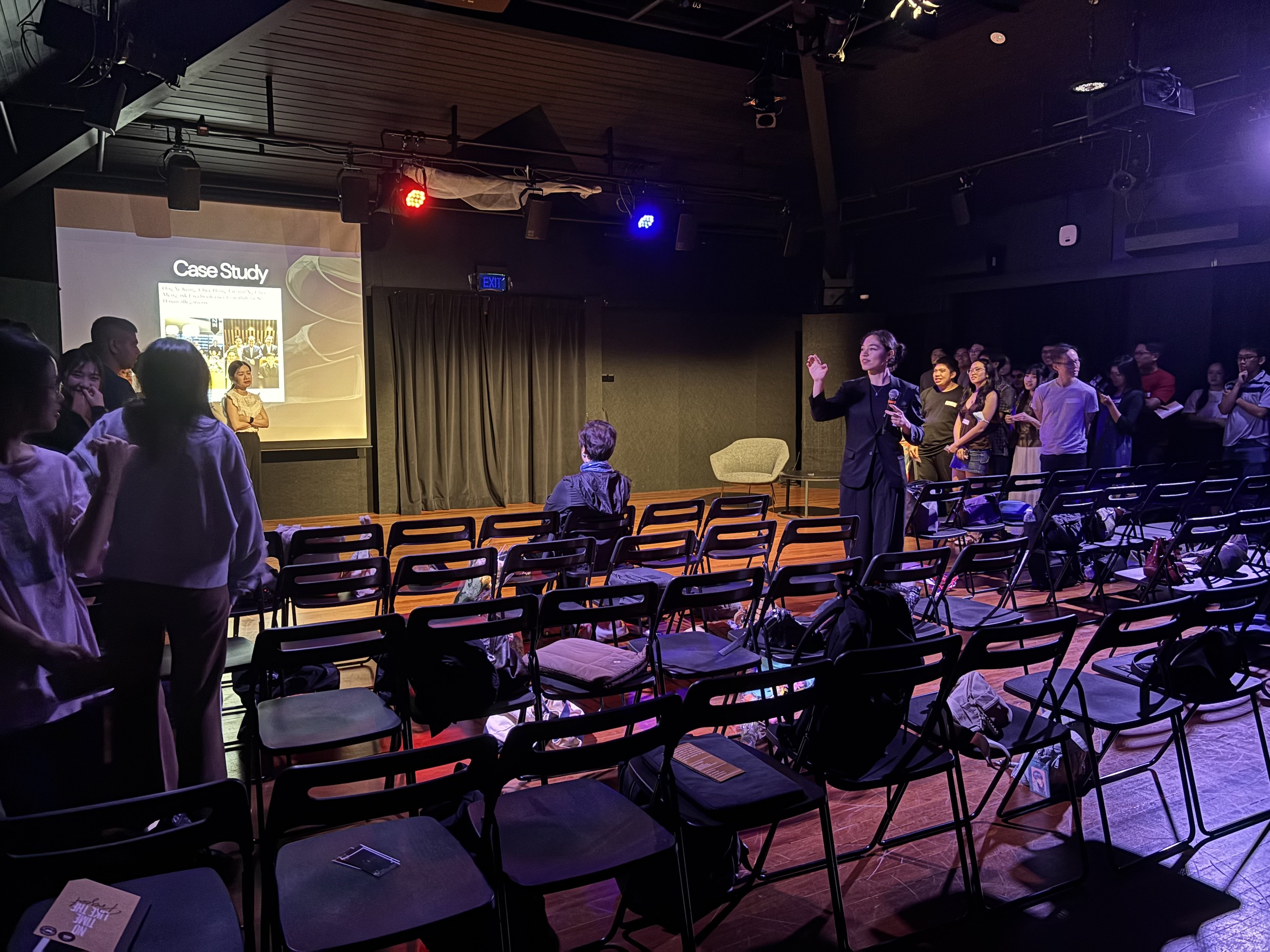
Audience participation in Defamation – Begins With Me, where audience members were prompted to split into two groups based on their opinion on a situated posed to them in the world of the performance.
At the end of the day, everyone does have an opinion, and they should know where they stand and why. It may not be a popular opinion, or it could be the popular opinion, but one should know why they are making that decision instead of just following the majority blindly.
RS: We hope that the audience takes away at least one of these understandings, enabling them to engage more actively as politically engaged citizens.
Firstly, through varied perspectives and responses to the WEB, we invite audiences to reflect on their own positionality and how political apathy can stem from societal and institutional constraints.
Secondly, by presenting accessible forms of resistance, we challenge the notion that activism must be large-scale, highlighting how individuals can contribute by starting in small ways interacting with their local communities.
Finally, rather than feeling trapped, we emphasise that change begins with self-awareness, empathy, and the choice to act for the collective good.
Published: 4 May 2026