What does it mean to curate?
This is a question that has quietly sprouted in my thoughts over the course of my summer internship with Centre 42. Somewhere in between documenting the theatre productions staged in 2025, and updating the C42 Archive of Singapore Theatre with records of past local productions, I found myself contemplating the magnitude and depth of my contributions as an archive intern.
The work of curation is believed by some to be reserved for professionals in the arts industries (Livingston, 2022), but truth be told, everybody curates. Some people design compelling art exhibitions that attract thousands; others build personalised Spotify playlists in the privacy of their own homes. Rather than an exclusive, specialised practice, I've come to see that the act of curation can be applied by anyone who consciously selects, arranges, and presents materials to produce a cohesive concept.
As a society, we seem to have embraced life in the age of curation, and to some extent, that is to be expected. The etymology of the word itself, tracing back to the Latin word curare, tells us that to curate is "to care" for something. This duty of care might come naturally to us humans; we tend to gravitate towards the pursuits that make us happy or fulfilled, and continue indulging in those areas of interest (Farooq, 2022). Essentially, I see curation as a labour of love; a concerted effort that reflects our deep curiosity and passion in a chosen subject.
Here at Centre 42, we specifically curate a digital repository of Singapore’s theatre history, the C42 Archive of Singapore Theatre ("C42 Archive").
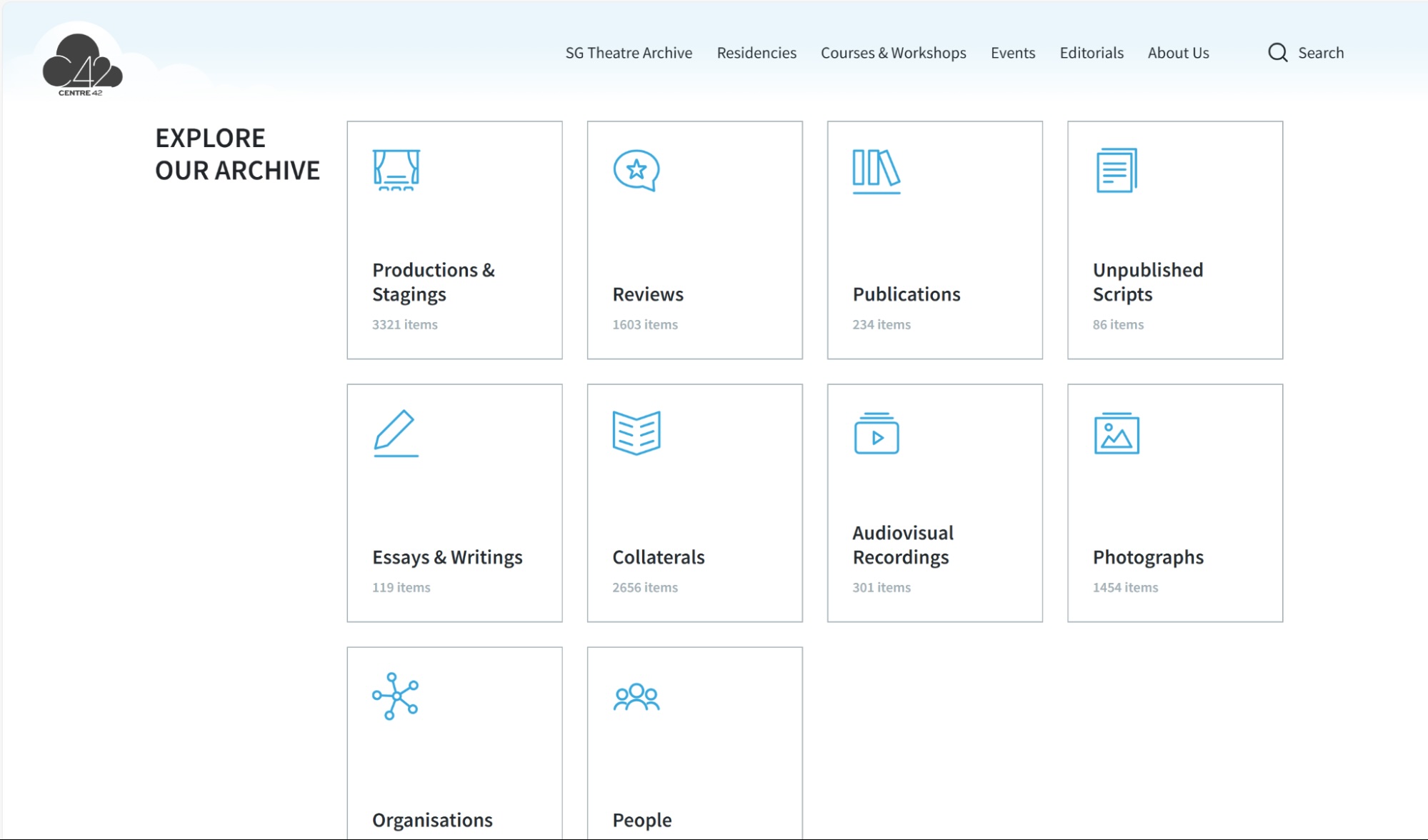
The C42 Archive landing page.
Once a simpler digital collection focusing on theatre collaterals, it is now a centralised network of information featuring over 20 thousand contributed artefacts, which reflect the evolution of local theatre since the country's independence. The work that goes into curating and maintaining this Archive is challenging, varied, and never-ending. Working at Centre 42 has affirmed my belief that curation is a labour of love, as I find myself surrounded by people who share a keenness and dedication to document the local theatre scene.
Yet while I felt a sense of pride from assisting in the curation and population of the C42 Archive, there were times when my enthusiasm was shadowed by a crippling sense of responsibility. Though my contributions were considerably small due to the short duration of my internship, I often worried that any mistakes on my part when working on the Archive could somehow impact the way the narrative of Singapore’s theatre history was told, and how it might be perceived through the eyes of an unsuspecting user. Funnily enough, it was this same paranoia that made me realise that curation was not the rosy picture I had imagined; it had its own can of worms waiting to be opened, and that can was filled with a terrifying prospect: that curation was potentially a form of censorship.
Curation, Censorship, and the Space In-Between
At first glance, curation and censorship appeared to me as having zero commonalities, existing as entirely different moderators of cultural production. Curation typically involved the collection, organization, and selection of artefacts for public display. These practices are the key ingredients driving the arts events to which audiences flock, shaping what, where, and how each artefact might be displayed and received by the public. The annual Singapore International Festival of Arts (SIFA), as well as The Studios (a seasonal series of theatre productions organised by the Esplanade), are examples of well-known programmes where the curation of performances and exhibits is paramount to the effective delivery of the event's themes.
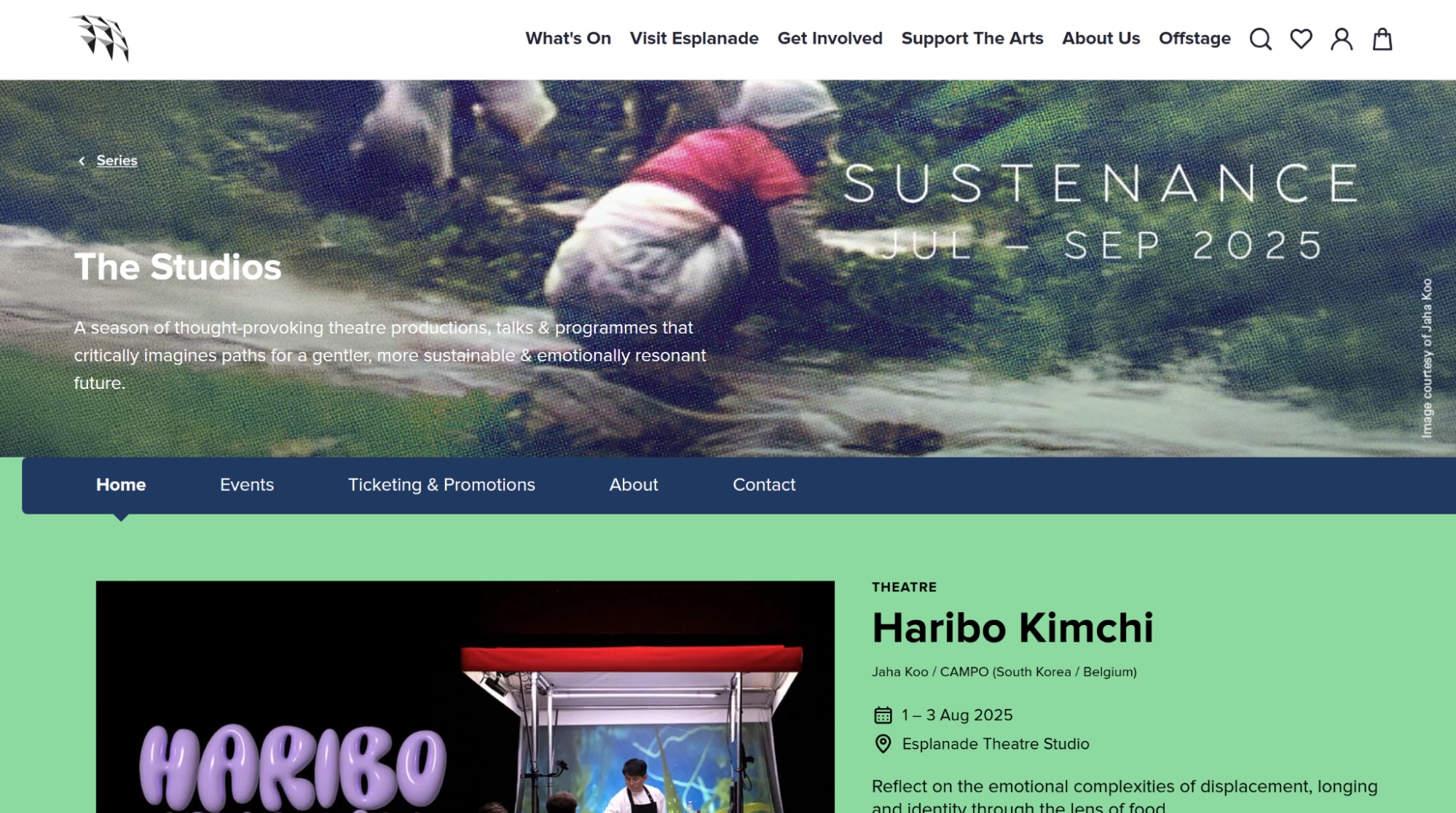
The Studios landing page.
Censorship, on the other hand, was a lot less generative, and came with a notoriously bad reputation. In a world which views free speech as extremely vital, people often value the freedom of expression without state interference, and thus share critical concerns when censorship knocks on their doors (Poushter, 2025). Censorship is a mode of suppression which filters the type of content that enters public domains, upholding a system of authority where power can dictate the form, medium, and level of expression (Jaeger et al., 2023). As such, censorship can be a slippery slope, since it has the capacity to shape the narratives circulated within public media.
Such restrictive regulation is widely regarded as antithetical to art itself, which is centred on creativity and the freedom of self-expression. In the realm of the arts, censorship can take the form of warnings, 'editorial requests', outright bans, and more. The Singapore theatre scene is no stranger to the above, having dealt with numerous cases of censorship since the very beginning, and continues to do so in the present day. In 1969, theatre doyen Kuo Pao Kun’s play, The Struggle, which focused on the social turbulence of that period, was banned by the government two weeks before its opening for expressing criticism towards their land redevelopment plans then (Chua, 2018). The injunction came abruptly, forcing the artistic team to stage a poetry recital and skits instead (The Theatre Practice, n.d.). Earlier this year in June, the authorities incited controversy with their decision to disallow theatre company Wild Rice staging a dramatised reading of Mitchell Fang's Homepar, just a day before it was set to happen (Raguraman, 2025). The authorities released a joint statement explaining that the revised script had not only contained changes that had yet to be approved, but the direction of the new script also clashed with Singapore’s anti-drugs stance. Nonetheless, this incident reveals how these tensions between state narratives and personal artistic expression have yet to be resolved.
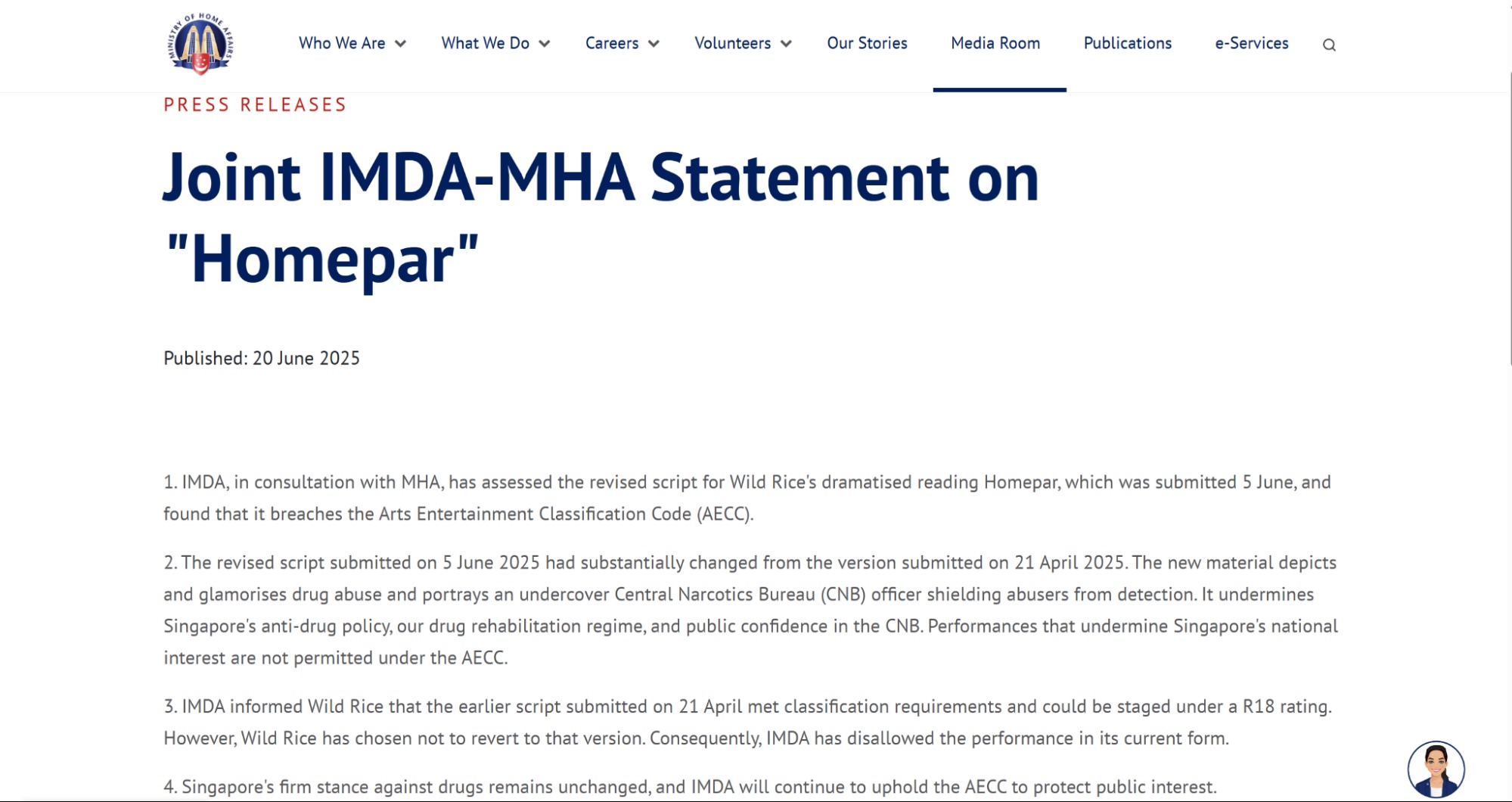
Joint statement on Homepar released by IMDA and MHA.
We can thus see that curation and censorship seem to occupy very different spaces within the art sector. Censorship, as we know it, is a deliberate act of media sanitising by those more powerful than others, and frequently positioned as the protection of societal values. On the other hand, curation is readily accepted as part-and-parcel of the interpretation process (Koskinen, 2024). However, therein lies the contradiction: are curatorial practices not equally capable of enforcing these same constraints, except that most people do not realise it?
Just as censorship inscribes a certain hierarchy of control, curators are also in a position to wield such power. We must remember that curatorial practices are not only subject to the curators' motivations and domains of knowledge, but also institutional interests that curators might represent. Depending on the agendas a curator or institution might have, an artefact is no longer confined to being a historical relic, but rather a tool for shaping public perception of realities. Even when curators attempt to be as neutral as possible, the nature of archiving transposes the artefact from its original context, re-contextualising it so that it is comprehensible to present-day audiences. Therefore, the artefact's historical background might be framed differently for it to be better understood by modern generations. By shaping the context of each artefact to weave into the overall narrative, curation becomes fundamental to influencing the audience’s takeaways from what is being showcased.
Perhaps the significance of curation is often overlooked because it typically involves behind-the-scenes work, which then becomes obscure to the audience after the production process is complete. Censorship typically occurs in the post-completion stage of content manufacturing where the public would have already been exposed to it, whereas curation engages with the ongoing development of the presented material. Unfortunately, this portends a sinister outcome: any censorial practices that occur during the curation period tend to receive minimal public visibility, and thus can very easily go unnoticed. Conducted within the privacy of the curatorial team, curation then becomes an avenue for 'soft' censorship to manifest.
'Soft' censorship is not the explicit government interference that we have come to antagonise, but it is just as detrimental. It is an implicit form of 'policing' that stems from internal biases, which actually makes it even more dangerous because these biases can be left unchecked (Cooke & Harris, 2023). Otherwise known as self-censorship, 'soft' censorship insidiously manifests in covert ways without receiving any pushback, which is enabled by the interior nature of curation. Libraries, for instance, are extremely vulnerable to 'soft' censorship when curatorial bias seeps into their operations, such as their collection development or selection for book displays. Book banning procedures, where libraries might avoid purchasing certain publications or prematurely remove titles from shelves that they perceive as not aligning with institutional or societal beliefs and norms, are other existing methods of 'soft' censorship.
Against the backdrop of Singapore’s meticulous media laws, which require productions to obey stipulated rules in order to gain licensing approval for public stagings, the issue of 'soft' censorship transforms into a fierce dilemma for theatre production teams and practitioners alike. Should they willingly stage contentious material, they risk incurring the government’s wrath and losing their public platform. Hard censorship is thus a catalyst for 'soft' censorship because it quietly pressures artists to self-censor and avoid transgressing the authorities' rules in the first place. Theatre practitioners and scholars alike have noted their concerns that Singapore's strict media policies may deter young creatives from being authentic and true to their work, prematurely stunting their own growth (Human Rights Watch, 2017; Fahira, 2021). These anxieties reveal how pervasive the ideals of the status quo can be, even when the perpetuator is ourselves and not the state authorities, like we expect.
The Myth of Neutrality in the Archive
Given that 'soft' censorship can curtail the level of artistic expression in theatre-making, it can also present certain complications in theatre archival efforts.
Archives can function as encyclopaedic resources of information, as well as creative avenues for artistic visions to be enacted. Regardless of how they are used, they help to document both the past and present, merging history with contemporary contexts. Working with the historicity of its artefacts, many archives would attempt to be as impartial as possible and strive for neutrality. This is because the archive has been traditionally portrayed as a site of objectivity that echoes the unbiased nature of its documentation procedures; a common yet false belief that record-keepers were simply making the material known to the world and not affecting how it is showcased (Kohn & Mckinnon, 2023). Such expectations can be exacerbated by the historical representations that curatorial archival practices are dealing with, which place an additional social responsibility on curators to maintain a commitment to authenticity and factuality in their practices. Moreover, it is helpful to note that archival repositories were once purely for state use, so the traits of neutrality and objectivity were crucial to not only accentuate, but also justify state power (Wilson, 2024). As these past dynamics build the foundation for how archives are perceived today, it is natural for many archives to endeavour for the embodiment of such characteristics.
However, try as they might, truthfully, the archive can never be completely neutral. Exposed to the curator's positionalities, the artefact's context can be irrevocably altered and adapted to their interpretation; it no longer exists in its original time and space. And since implicit biases exist in every one of us, complete objectivity becomes almost impossible to achieve. Take Centre 42 as an example - the positionality of each team member working on the C42 Archive has implications on the veracity of the information presented. One of the ways in which the C42 Archive strives for neutrality is by democratising the definition of local theatre - instead of creating and abiding strictly by its own definition of 'theatre', the productions and stagings included on the Archive are those that have been defined by their creators as being 'theatrical productions'. And yet, such a method is not foolproof, as vocabularies continue to evolve and external definitions are contested. There have been many conversations within the team about whether a production should be considered 'theatre', and thus included on the C42 Archive. Each member's different point of view is coloured by their own understanding of 'theatre', too.
This issue is not unique to the C42 Archive. Seasoned curators from all over have blindspots; their socio-cultural background shapes the type of theatre they are familiar with, which may lead to certain genres enjoying greater depth and breadth of content over others. As much as it is a historical record, it is imperative to recognise that the archive interacts with both subjectivity and objectivity (Alessandrini, 2018), existing as a site of contradictions and paradoxes.
Neutrality - A Necessary Ideal?
So where do we go from here? Do we just accept that we are doomed by our own fallibilities? We certainly cannot wish this problem away. When curatorial practices are entwined with 'soft' censorship, the archive’s legitimacy becomes problematic, and the issue becomes harder to resolve when the personal becomes professionalised. For curators, their experiences are fundamental to the work they produce, and their occupation necessitates them filling in the gaps with their perspectives for the benefit of the archive users. Hence, depending on the curator's background and preferences, certain narratives might be downplayed, or sometimes favoured over others. This then complicates the archive's stand on several sociocultural issues: does it promote the status quo, or does it seek to spotlight ideas that remain on the periphery? If an archive is committed to preserving history and memory, its curator bears a heavy burden of determining what or whose history is being represented. Archives are even more vulnerable to the proliferation of 'soft' censorship when decision-making processes are left up to the curator's discretion and lack the necessary whistleblowers to minimise internal bias, given the subtle yet pervasive nature of 'soft' censorship.
It might arguably be more productive for archives to distance themselves from the label of neutrality, given that it is a truly impossible feat. In some ways, neutrality can become a convenient excuse for institutions to refrain from addressing crucial oversights and taking genuine action to correct their mistakes. Moreover, by assuming a neutral positionality, we might in fact be accommodating the hegemonic norm, which marginalises any form of deviance. Perhaps the way forward is to destigmatise the idea of non-neutrality. By accepting that neutrality is a false ideal built off social structures which benefit the privileged, curators are more conscious of the biases present in their work and can safeguard against 'soft' censorship more effectively.
This idea is, indeed, shared by many archives today, which demonstrate a growing consciousness of the inherent biases present in their decision-making processes, and have adopted various strategies to maintain the inclusivity and cultural humility of their sites. For example, The Huntington, a collections-based educational and research institution, has a library statement on their website that distinctly acknowledges the futile pursuit of neutrality, and instead provides a detailed explanation for their management of harmful descriptive standards.
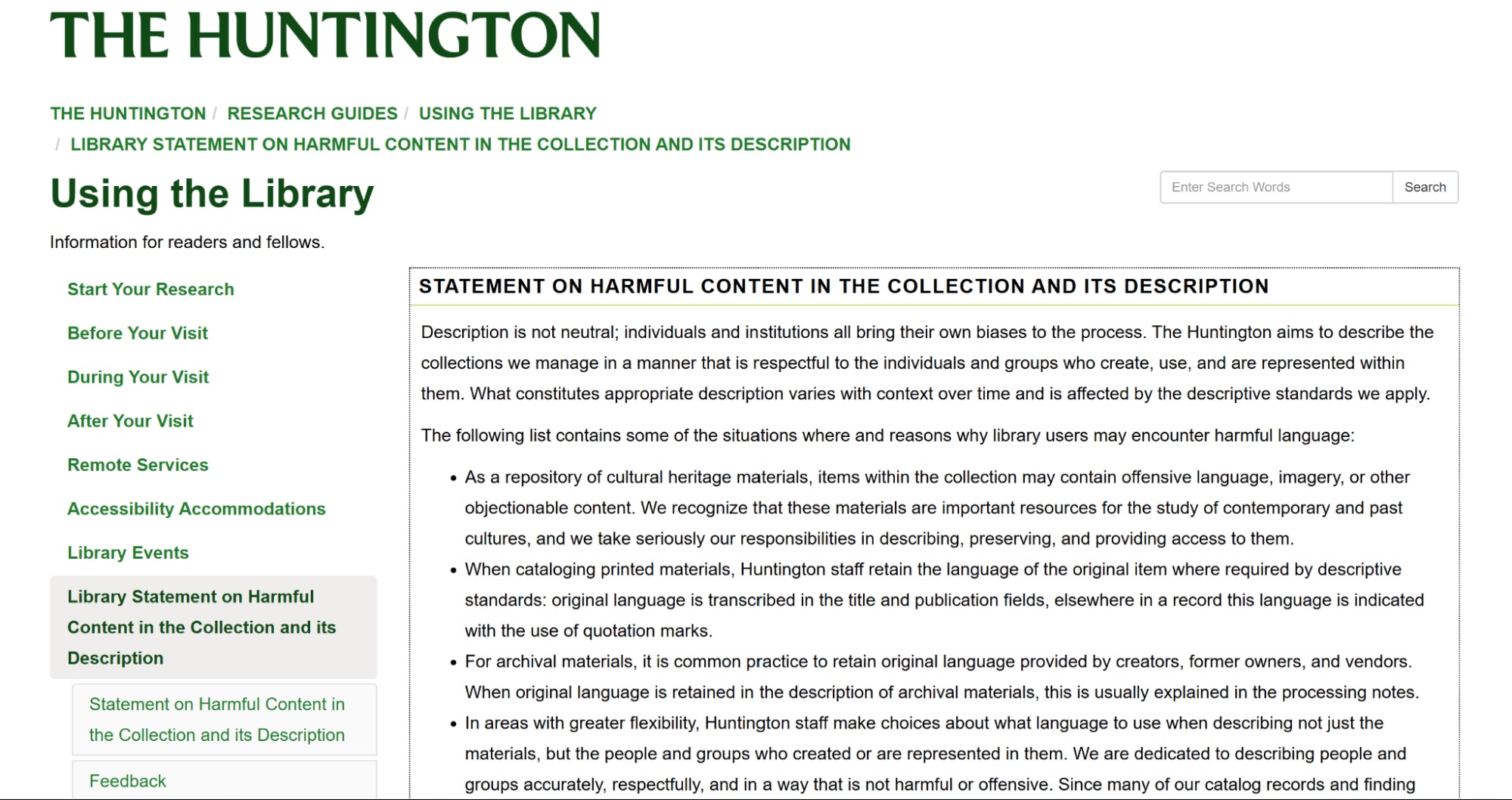
The Huntington's Library Statement on Harmful Content.
Similarly, the Folger Shakespeare Library recognises how their historical infrastructure re-contextualises their materials, making it impossible to view them through a wholly objective lens. Instead, they make an explicit commitment to magnify the voices of Indigenous researchers and creators who contribute to the repository.
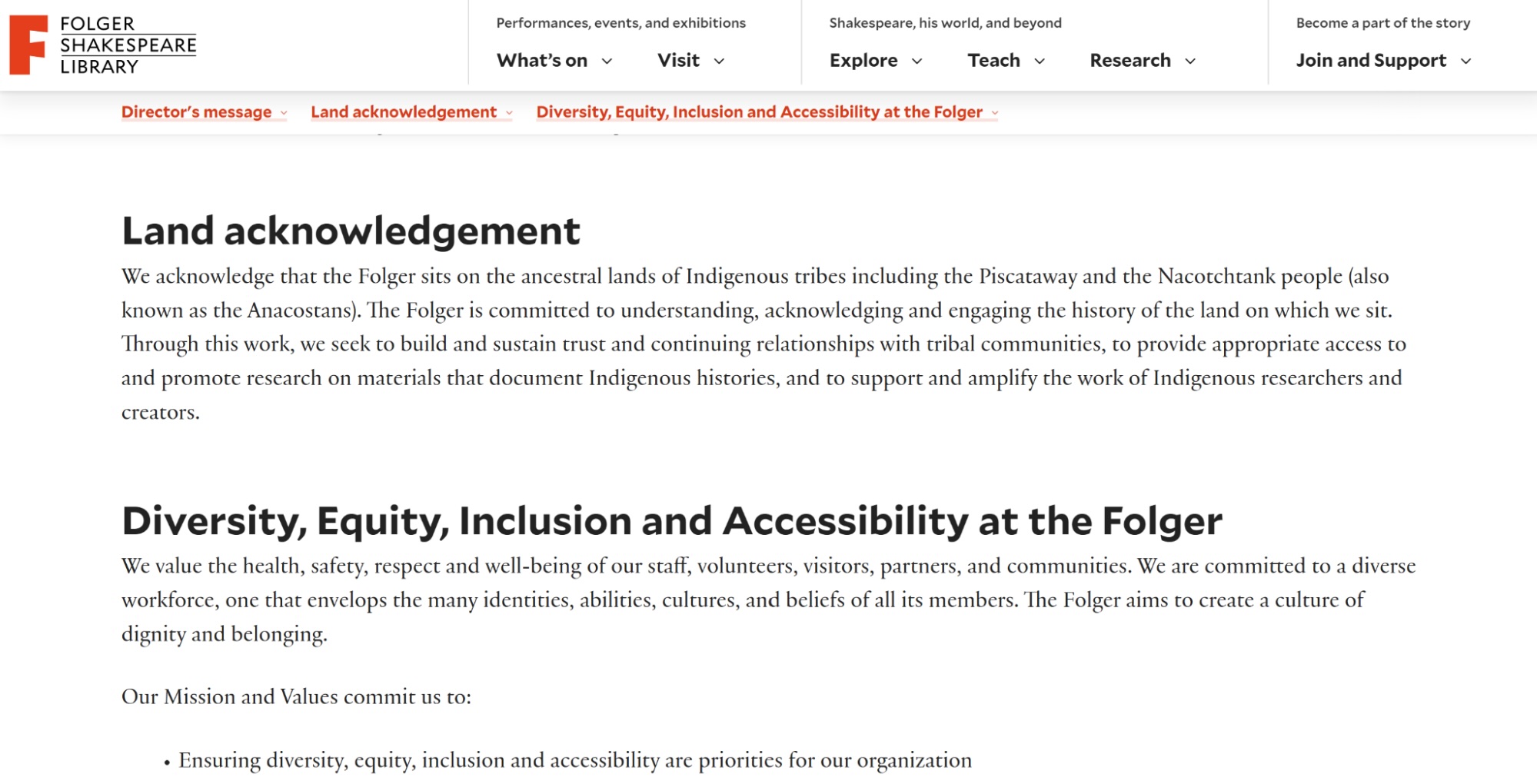
Folger Shakespeare Library's Culture and Values page.
These examples are merely two of many, but they reveal an ongoing commitment by archival teams to expand the accessibility of their archive, especially with regards to marginalised communities who lack control over their representations in the media (Wright, 2022).
Conclusion
In an age of severe misinformation and volatility, it is worthwhile to think about the curatorial agencies present in archival and their implications surrounding the veracity of the archive. Ultimately, when we curate and archive, what are the responsibilities we must carry? And what gets lost in translation?
Would censorship, by any other name, seem as sinister? Curation may not antagonise the concept of free expression the way censorship often does, but this does not mean that curatorial practices are devoid of censorious procedures. A culture of accountability is paramount if we want to ensure that the practice of curating archives does not harm the stories it aims to represent. When curatorial and archival processes lack self-reflexivity or transparency, they can become just as problematic as overt censorship policies.
Curation may not be equivalent to censorship, but it is vital that we recognise how it can enable biased policing and sanitisation to manifest in our art-making and archival practices, to their detriment.
Published: 7 October 2025